
NGO Business Model Development
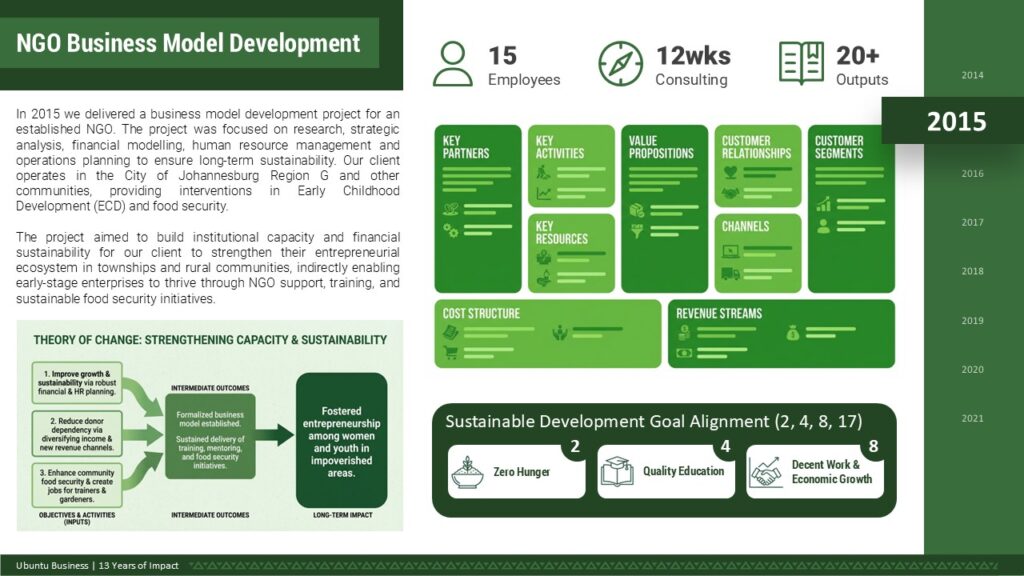
In 2015 we delivered a business model development project for an established NGO. The project was focused on research, strategic analysis, financial modelling, human resource management and operations planning to ensure long-term sustainability. Our client operates in the City of Johannesburg Region G and other communities, providing interventions in Early Childhood Development (ECD) and food security.
The project aimed to build institutional capacity and financial sustainability for our client to strengthen their entrepreneurial ecosystem in townships and rural communities, indirectly enabling early-stage enterprises to thrive through NGO support, training, and sustainable food security initiatives.
Objectives and Theory of Change:
The project aimed to strengthen capacity to:
- Improve growth and sustainability through robust financial and HR planning.
- Reduce donor dependency by diversifying income steams and introducing new channels of revenue.
- Enhance community food security while creating job opportunities for trainers and gardeners.
By formalizing their business model, our client was able to sustain delivery of training, mentoring, and food security initiatives to foster entrepreneurship among women and youth in impoverished areas.
Delivery and Reach:
The project involved:
- Conducting SWOT, PESTLE, Five Forces, and Value Chain analyses
- Designing a Balanced Scorecard with financial, customer, and HR targets
- Developing pricing models for with margin projections
- Preparing salary benchmarks and HR policies, with a projected HR budget
- Drafting an annual marketing budget
- Preparing revenue projections for training
Beneficiaries:
Direct beneficiaries were the client staff and management team, while Indirect beneficiaries included:
- ECD practitioners and facilitators trained through accredited programmes.
- Community gardeners engaged in the township food security programmes.
- NGO employees seeking additional income opportunities through food garden projects.
Results and Impact:
The project outputs were centred around institutional systems, tools and templates, including deliverables such as:
- Operations manual and company handbook aligned with South African Qualifications Authority standards.
- HR systems, salary scales, policies, job descriptions, performance management procedure and template).
- Marketing and fundraising strategies, including social media marketing and direct corporate outreach strategies.
- Revenue models and projections for Agri-SETA accredited training and follow up mentoring services.
Key Lesson:
Robust financial/business models for intermediaries are essential, but must be matched with field-level monitoring of entrepreneurial and livelihood outcomes.
Disaggregation Details:
- Provinces reported: Gauteng; future expansion national.
- Sectors: ECD training, food security, agriculture consulting.
- Demographics: Missing – Author Review.
Risks, Mitigations, Lessons
- Risk: Over-reliance on CSI funding. Mitigation: diversify revenue via fee-based training.
- Risk: Limited HR capacity to scale. Mitigation: introduce new posts with clear policies.
- Risk: Low uptake in new regions. Mitigation: phased geographic expansion.
SDG Alignment
- SDG 2 (Zero Hunger) – food security and agribusiness training.
- SDG 4 (Quality Education) – accredited ECD training.
- SDG 8 (Decent Work & Economic Growth) – HR/job creation for trainers, gardeners.
- SDG 17 (Partnerships) – working with CSI funding, NGO–corporate partnerships.
External Context Suggestions (South Africa)
- Stats SA QLFS 2024: high youth unemployment; frame entrepreneurship as livelihood pathway.
- GEM South Africa Report 2022: entrepreneurial activity trends, necessity-driven entrepreneurship.
- National Treasury “Financing a Sustainable Economy” 2020: SME credit/gap in township economies.
- SEDA Annual Report 2023: small enterprise development performance in SA.
- DBE ECD Sector Policy 2015: national ECD reform baseline.
- ILO Decent Work Country Programme 2022–2025: labour market context.
“Our services lift entire communities through food and education pathways.”
In Lawley, Region G, ERP combined its food security programme with ECD centre support. While training facilitators in SETA-accredited early childhood development, the project also introduced permaculture food gardens, supplying both nutrition and learning environments. This integrated model demonstrates how organisational capacity building in budgeting, HR, and marketing ensures sustainability of grassroots benefits.